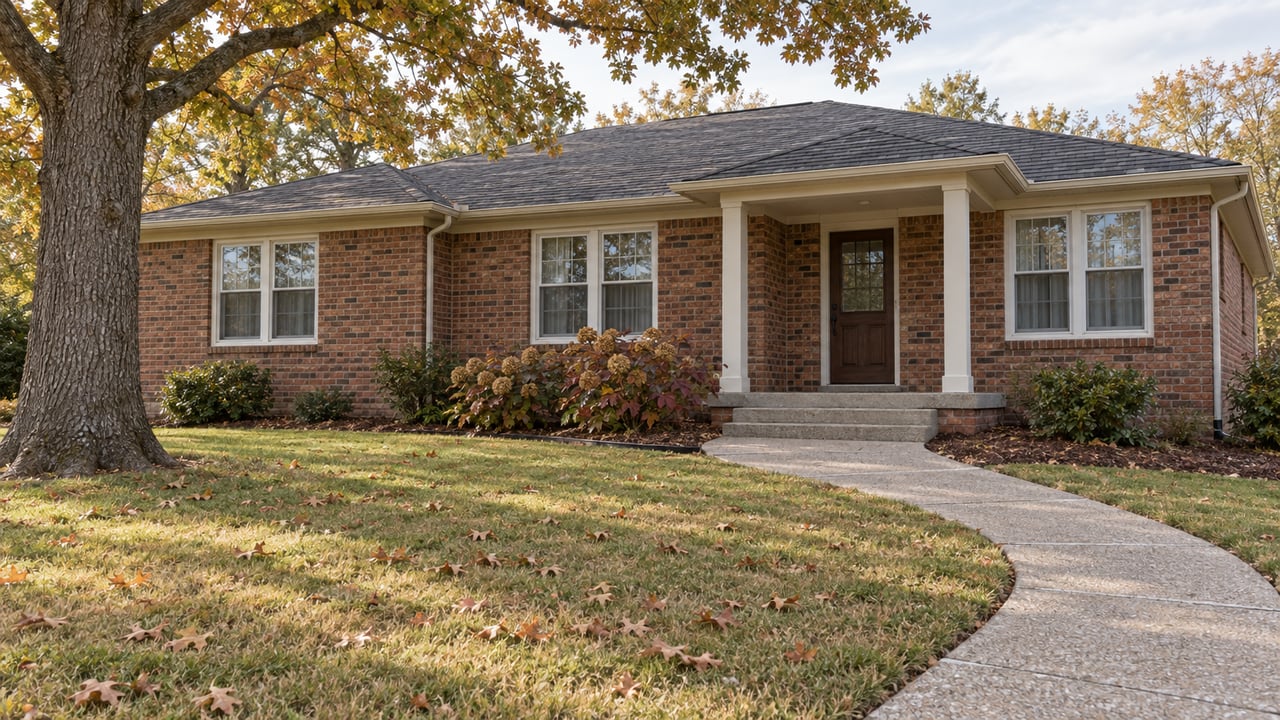
Why the Seller's Tax Bill Won't Be Yours: How Hall County's Homestead Caps Reset at Closing
November 12, 2026
November 12, 2026
The annual tax figure on a Hall County listing tells you what the current owner pays. It doesn't tell you what you'll pay. Since 2025, homesteaded homes in Hall County have been taxed on values that can only rise so fast each year. Those limits belong to the owner. They don't transfer with the house.
So when a buyer budgets a monthly payment around the seller's tax bill, the number they're using comes from the seller's exemptions. It was never a fact about the house. Under the new caps, how far it lags the house's market value depends mostly on how long the seller has been capped and how quickly values climbed in that time.
Hall County's own homestead exemption FAQ explains the new exemptions in plain terms. They limit how much a home's assessed value can rise in a year, to 3% under the local acts or to the rate of inflation under the statewide law. The county stresses that "they do not freeze the value."
The same FAQ explains what happens at a sale:
"If an individual sells their home, the taxable value of that home resets to fair market value for the next owner. Similarly, the individual cannot carry the value of the exemption to their new home."
That reset is the whole mechanism. While a seller lives in the home, the taxable value follows the cap. When you buy it, the taxable value starts over at market value. The seller's bill was built on one number and yours will be built on another.
The size of the gap comes down to two things: when the cap's clock started and how fast the market moved after that.
For Hall County government taxes, the local cap comes from HB 1268. It limits the base value's growth to 3% a year. For an exemption first granted in 2025, the base is the home's 2023 assessed value. A parallel act, HB 1270, does the same for Hall County School District taxes, also using 2023 as the base.
That means a homeowner who got these exemptions in 2025 is taxed against a starting point that's already a few years old. Any market growth above 3% a year since then doesn't reach their county or school taxable value.
The county's levy history shows how quickly the overall tax base has grown. Hall County's five-year history of levy report lists a net digest of $14,980,118,207 for 2023 and $16,285,878,544 for 2024. That's roughly an 8.7% rise in a single year. By the 2026 levy, the county's general fund resolution used a tax valuation of $17,921,504,938. Those figures cover every kind of taxable property, commercial and industrial included, so they don't measure home prices directly. They do show a tax base growing well past 3% a year, and the 3% cap is what separates a capped homeowner's taxable value from that growth.
The statewide floating exemption from HB 581 works the same way, with a different growth limit. Its base for 2025 was the 2024 assessed value, and inflation indexing began in 2026. The Georgia Department of Revenue's 2026 inflationary index bulletin, issued January 13, 2026, set this year's index at 2.7%. State law says the exemption doesn't pass to a later owner.
This is where Hall County gets trickier than the guides written for Georgia in general. Each taxing authority decided separately whether to opt out of HB 581, so one home can be valued one way for county taxes and another way for school taxes.
The Georgia Secretary of State's HB 581 list records who filed opt-outs by the original deadline:
| Taxing authority | HB 581 status on the state's opt-out list | Local 3% act on record |
|---|---|---|
| Hall County government | Opted out | HB 1268 |
| Hall County School District | Not on the list | HB 1270 |
| City of Gainesville | Opted out | HB 1269 |
| Gainesville City Schools | Opted out | HB 1271 |
| Oakwood | Opted out | n/a |
| Clermont | Opted out | n/a |
| Flowery Branch | Not on the list | n/a |
| Lula | Not on the list | n/a |
| Gillsville | Not on the list | n/a |
Hall County's FAQ speaks to the county and school split directly. Because county government opted out and the school system didn't, "you may have two different assessed values on your home." That only happens when HB 581 gives the homeowner more benefit on school taxes than the local act does. Otherwise, school taxes use the same value as county taxes.
Back to the listing. A seller's bill can reflect two different capped values, each on its own base year and growth limit, and each one resets when the home sells. The tax line on the listing is the total of all of them. A buyer can't tell from that single figure how far each piece will move.
The reset changes the value you're taxed on. Location changes the rate you pay on it. Hall County adopted its 2026 millage rates on August 27, 2026, after public hearings on August 13, 24 and 27. AccessNorthGA reported the resulting county totals, which depend on where a property is located:
| Where the property is | 2025 county total | 2026 county total |
|---|---|---|
| Unincorporated Hall | 7.815 mills | 7.702 mills |
| Incorporated, outside Gainesville | 8.115 mills | 8.037 mills |
| City of Gainesville | 3.798 mills | 4.1 mills |
The required public notice advertised a 14.12% increase. That figure covered only the county General Fund, which went to 3.565 mills, 0.441 mills above the rollback rate. The county said in its August 5 clarification that the added General Fund money will help pay for court operations tied to Hall County's sixth Superior Court judge. Cuts in the fire, emergency services and development services districts more than offset that increase for most residents. Board of Commissioners Chairman David Gibbs said in the same release that "the majority of our residents will see an overall decrease." Gainesville city residents pay only the county General Fund and Emergency Services rates, so their county total went up.
The county total is just one layer. The Hall County School District's 2026 levy is 15.490 mills for operations plus 1.000 mill for bonded debt. In Gainesville, AccessNorthGA reported city rates of 0.722 mills for general government, 1.299 for fire, 0.712 for police and 0.896 for parks and recreation, along with a city school levy of 6.492 mills.
Put together, the comparison buyers usually make, house A's tax line against house B's, is mixing two variables. One is how much of a capped base each seller carries. The other is which combination of county, city and school rates each address falls under. Only the second one carries over to you.
For anyone closing this fall or winter, a few dates matter.
The first assessment notice a new owner gets, with taxable value reset to market, is often the first time they see what the house costs to own.
Does buying a home with a big exemption help me? The county FAQ says these exemptions "do not stay with the property nor the property owner when a change in ownership occurs."
If I add on to the house, does the cap still hold? Hall County's FAQ notes that most of these exemptions account for substantial changes. If an owner doubles the size of the house, for example, the base-year value can be raised, and the cap applies to the new base from then on.
Do the new caps replace my other homestead exemptions? The county says they don't eliminate existing homestead exemptions in any jurisdiction, though they may override some of them.
This post is general information, not legal, tax or financial advice. Tax treatment depends on the specific property and owner, so please confirm your own numbers with the Hall County Tax Assessor, the Tax Commissioner, or a tax professional before you budget around them.
If you're comparing homes across Hall County and want help figuring out which part of a listing's tax figure belongs to the seller and which part comes with the address, The Jason Buffington Realty Team is happy to go through it with you before you write an offer. Schedule a No-Pressure Consultation and bring the listings you're considering.
We've helped many others find their dream home or sell their current one. A home buying or selling consultation costs you nothing. That's a fact. We want to educate and serve you. Give us the opportunity to speak with you today with a 'no pressure' conversation. We're here for you.

The Jason Buffington Realty Team
631 Dawsonville Hwy Gainesville, GA 30501 KELLER WILLIAMS LANIER PARTNERS